Are You Up to Date With Your Sexual Education? Going Under the Covers With Sexual Health
As a mother of a daughter who has just become a teenager, her sexual education is something I’ve been thinking more about and wondering whether we’ve taught her what she needs to know for her age. We’ve always been pretty open with her about that stuff, as my mother was with me, but it’s so hard to know whether they know what they need to know.
I always knew I could talk to my mum about pretty much anything, which I think really helped me to be aware of and armed with the information I needed as a teenager starting a sex life, and I hope that will be the same for us.

I think it’s easy as a parent to rely on their school to teach them ‘the embarrassing stuff’ and at the correct time, but sexual education in schools is severely lacking, as priority is given to academic subjects. There is such a need for young people to be taught information and skills that will help to prepare them for life, rather than just the standard subjects that they may well never use again as an adult, and sex education is a big part of that.
It’s very different now with the online world and social media, and children and young people being able to access the information they want, and I think that’s great, especially for those with parents who are not willing or able to talk to them about it.
However, there is a huge risk of inaccurate information being shared online, so it’s not a foolproof way to learn about sex and sexual health.
It’s so important for our children as well as for ourselves that we become more open to talking about sex and our sexual health and that we try to remove the stigma around it.
Sexual health outcomes across the UK have got significantly worse, and according to this House of Commons Committee report, there has been a recent increase in levels of sexually transmitted infections (STIs) in the UK. This is due to a number of factors, including stigma and a lack of education. There was also a £171 million reduction in sexual health services spending from 2016/2017-2022/2023.
In response to this report, Curely conducted a survey of 600 adults to find out more about the general public’s attitudes to sex, asking them questions about sex education, perception of sexual health, sexual health conditions, STIs and contraception.
The survey explores the importance of educating yourself on sexual health and the potential dangers of just relying on information you read on the internet.
This is important to talk about to break the stigma around sexual health, as well as teach our children what they need to know and where to seek information. It would be amazing for them to be able to grow up discussing protection and sexual health openly with partners or medical professionals, reducing the risk of unwanted pregnancies, STIs, and subsequent long-term health impacts.
Sobia Qasim, Superintendent Pharmacist at Curely, said:
“The 2024 report highlights the urgent need for improved sexual health education and better access to services, particularly for young people. The rise in STIs is alarming, and the report’s recommendations, including those aimed at enhancing the role of online providers in delivering accurate information, are crucial steps toward addressing this public health issue. As healthcare providers, we must support these initiatives and work to reduce the stigma that prevents many from seeking timely care.”
Sex education in schools
As mentioned above, sex education in schools is severely lacking – it was when I was at school, and unfortunately, it still is now. I would say our daughter has learnt the majority of what she knows from us rather than from school. Thankfully, at least at the moment, she is happy to ask me about something if she has heard it mentioned and wants to know what it is.
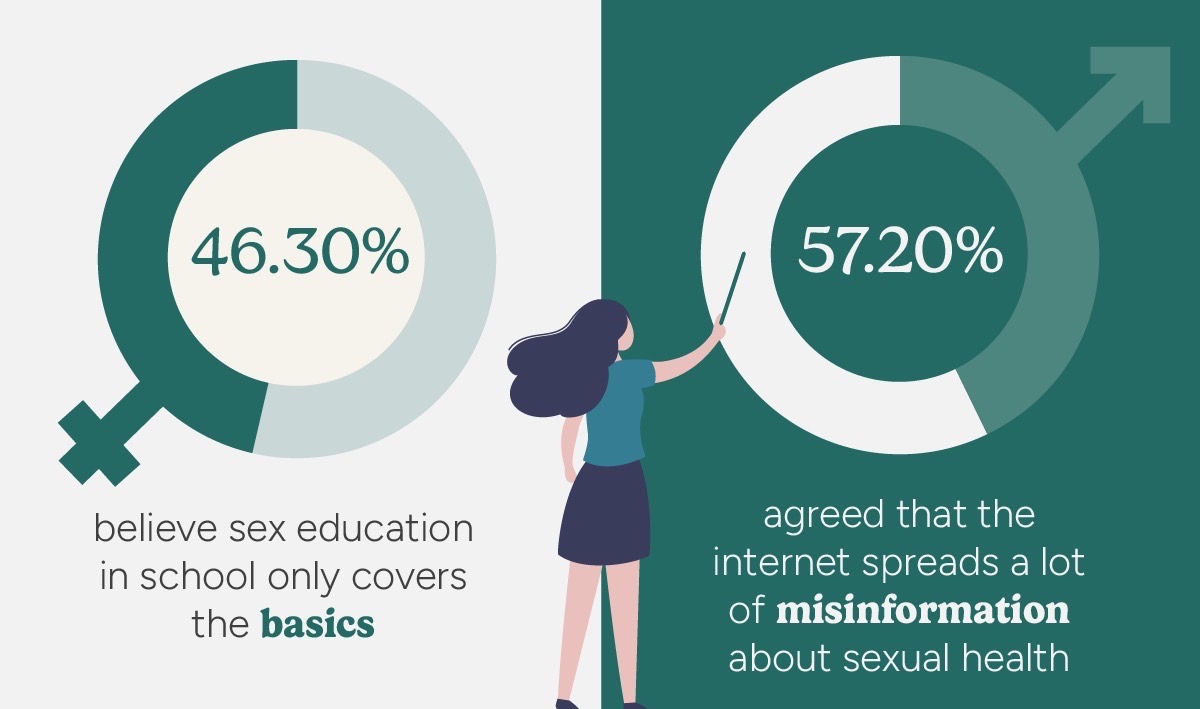
In the survey, nearly 20% felt their sex education in school left them ‘not at all’ prepared for real-life situations, and whilst just over 46% said it covered the basics, that is clearly still not enough.
Research done by the Department of Education in 2021 backs this up, with many young people saying their PSHE teaching at school was so poor that they learned most of it online.
The Internet is a great resource for us to learn about all sorts of things, but unfortunately, it isn’t regulated for quality or accuracy, making it dangerous for young people to use it as a source alone. False information can spread easily, especially via social media platforms such as TikTok and Twitter (X!).
This highlights the importance of accurate, thorough sex education in schools, teaching children about risks and prevention, and encouraging them to be open with partners and health professionals.
The stigma of talking about sexual health
Taking care of your sexual health is so important, which means feeling comfortable seeking help from a medical professional when something feels wrong. There is currently a lot of stigma involved (although I do think it’s getting better), especially around the subject of STIs, and many of us still feel too embarrassed to seek help.
Nearly 30% of people in the survey said they had never discussed their sexual health with a healthcare provider. While not everyone may have had concerns, nearly a third admitted avoiding the topic due to embarrassment.
Reducing stigma is key to making these conversations easier, starting in schools to help young people feel comfortable discussing sexual health with doctors or parents as they grow up.
Discussing STIs and sexual health with a partner
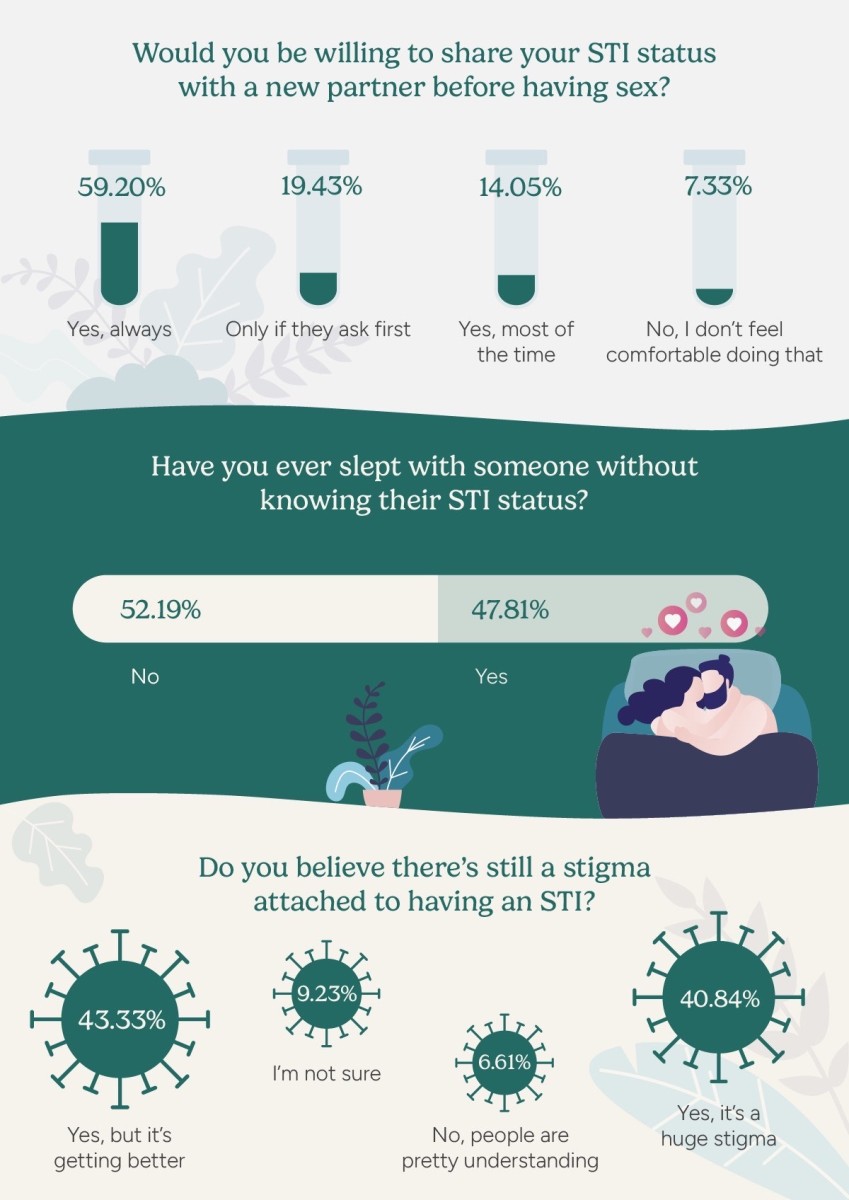
Nearly half of survey respondents admitted to sleeping with someone without knowing their STI status. I think this is scary but not a surprise – in fact, I suspect some people weren’t honest with this. In my experience, we’re not taught to discuss STI status with partners or that regular testing is essential once sexually active, especially with new partners.
It’s so important that we discuss our sexual health and STI status to protect both partners. This just highlights to me the importance of sex education in schools and being as open as possible with our children so they feel comfortable talking to their partner and seeking advice where needed from us or a doctor.
STIs are on the rise
STIs are rising, particularly among 15 to 24-year-olds, which is worrying, especially given the potential long-term effects, which can include serious issues such as infertility.
It’s hard for teens to think beyond the moment and how something could affect them later in life, but understanding the serious consequences of avoiding discussions and tests is so important.
STIs aren’t going away, so using protection and getting tested regularly ensures early treatment and, therefore, shouldn’t impact future health. Open conversations with new partners can also reduce stigma and show that long-term relationships with someone managing an STI are both safe and possible.
32% of the people surveyed said they wouldn’t engage in a long-term relationship with someone having treatment for a sexual health issue, whilst 30% would but with reservations.
The more we talk about it, the less stigma there will be for all of us, and particularly our younger generations.
A decrease in contraception use
Condom use has significantly declined among sexually active adolescents since 2014, according to the World Health Organisation (WHO), putting them at higher risk for STIs and unplanned pregnancies.
Potential reasons for this decline could be due to a lack of comprehensive sex education, an increased reliance on other contraceptive methods like the pill (which doesn’t protect against STIs) and a perceived decrease in HIV risk.
In the survey, only 28% used contraception every time, while 72% were split between most of the time, never, rarely and occasionally – the reasons given for this being due to concerns about side effects and their effectiveness.
The UK Health Security Agency is calling on the Government to promote the benefits of condom use to ensure safer sex. It would also be beneficial for young people to be more widely taught about alternative methods of contraception, such as internal female condoms, which could give women more control over contraception and help reduce STIs, including for those in same-sex relationships and in oral-sex situations.
A need for better sex education
It’s clear that we need to continue to have open conversations around this topic to reduce the shame, embarrassment, and lack of knowledge we have.
It drives me crazy the lack of education we’ve been given about our health, particularly as women, with a lack of knowledge and understanding about things that really affect us – our sexual health, hormones, fertility and menopause – all of which play a big part in our lives.
It’s important that we educate ourselves on our sexual health, without relying on information on the Internet and teach our children to do the same thing.
We have to try to overcome the stigma we feel by going to see our doctor if something feels wrong or if we need advice. If we’re sexually active, we have sexual health, which is the vast majority of us as adults, so there shouldn’t be any stigma attached to it.
As the survey shows, many haven’t always used protection or had regular health checks, so if we suspect an STI or notice a change, we shouldn’t feel embarrassed to get checked.
There are safe spaces to talk about sexual health issues, including STIs. Healthcare professionals are there to support people of all ages in getting the help they need, so if you have any concerns about your sexual health, please get in contact with your doctor or local sexual health clinic.
In collaboration with Curely.
Sources:
- https://www.nhs.uk/conditions/ejaculation-problems/
- https://www.brook.org.uk/your-life/stis-and-stigma/
- https://publications.parliament.uk/pa/cm5804/cmselect/cmwomeq/463/report.html
- https://www.nhs.uk/conditions/erection-problems-erectile-dysfunction/
- https://www.nhs.uk/contraception/methods-of-contraception/internal-condoms/
- https://www.who.int/europe/news-room/29-08-2024-alarming-decline-in-adolescent-condom-use–increased-risk-of-sexually-transmitted-infections-and-unintended-pregnancies–reveals-new-who-report